AI

A couple of days ago I signed up to The Human made Webring, a ring for people actively avoiding AI on their own web sites. That is not all of the philosophy of course, but I have a confession. Not a deep or in-depth confession.

I use AI.

I have been thinking, how do I use it?

Most of the time it is entirely involuntarily. That said, I do try to avoid it wherever I can:

  • I switched AI off on my iPhone. Being honest, when I last tried it, it was not much help, especially attempting to summarise incoming messages or grouping alerts. Now there may be a time when it’s unavoidable, you know how fashions go.
  • It’s switched off at Github.com. I do not code much but when I do I prefer to do things myself (yes, with help from StackExchange.com).
  • I use the Kagi.com search engine (without its AI). It simplifies search, no AI summary, no ads, no sponsored content. It finds stuff without the guff.
  • I haven’t touched Facebook for a while. It’s sometimes necessary to find out what’s happening locally or for shop opening times. I do use WhatsApp because I’d struggle to keep in touch with people I care about – those who don’t use Mastodon.
  • Twitter is occasionally a necessary evil for hyper-local news.
  • My car is over 16 years old and not even the clock updates automatically. I don’t know if I’d have auto updates by spending the extra £1,000 for the top of the range version. But even that just had more things to potentially go wrong.
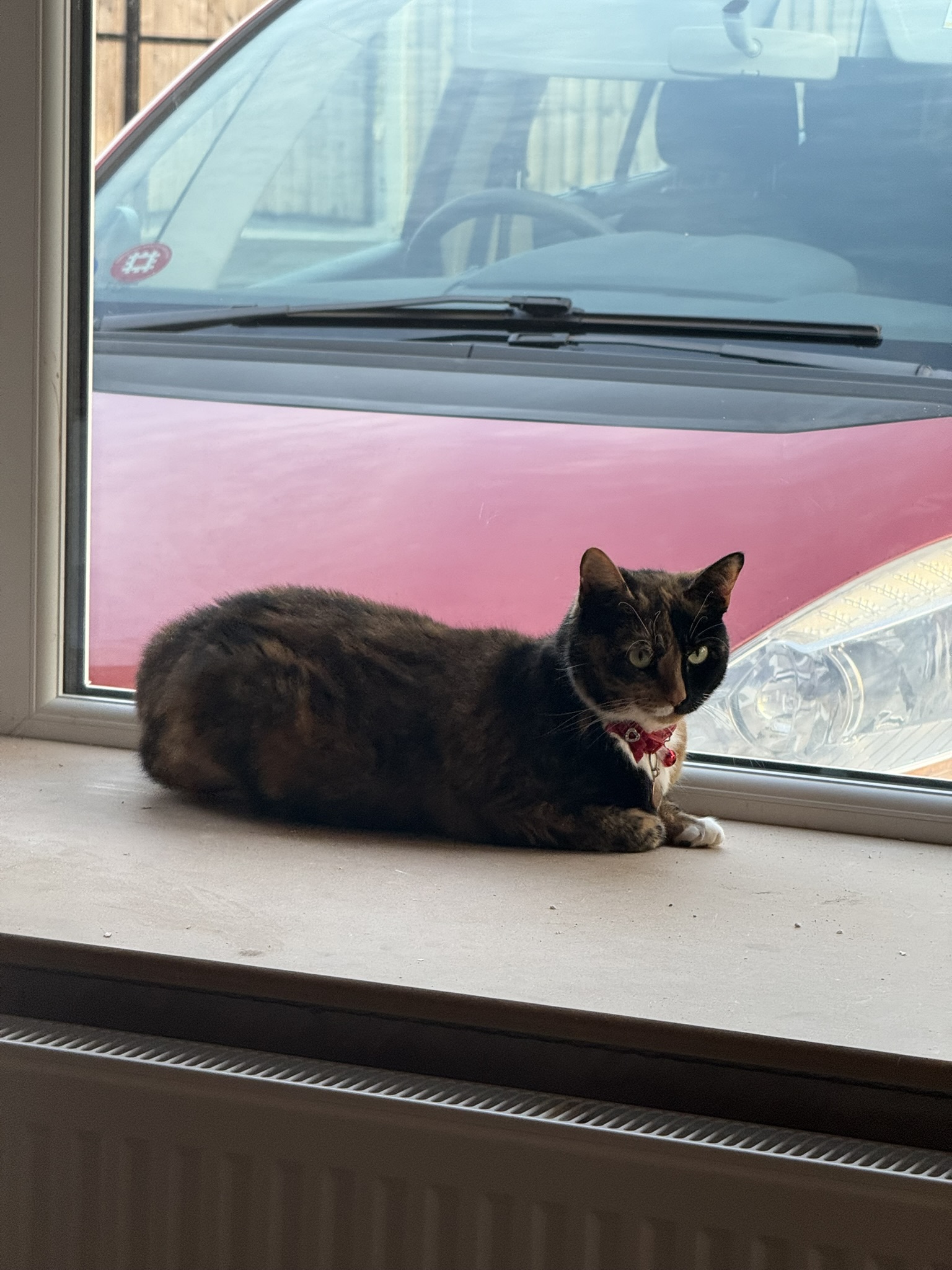
Stella cat sat on a window ledge. Through the window a quite old red car with not much in the way of modern tech, and certainly no AI.

When I cannot avoid AI:

  • I scroll past it at work when I’m using Google or Bing. (I’m not paying for Kagi at work). I’m only enough to remember an internet without Google. The problem is, I could probably save time by using the data in the AI summaries, especially some of the more technical stuff.
  • I check sources sent to me from colleagues. It’s not that I don’t trust their judgment, it’s just I’ve learned a lot through bitter experience.

What I’m unsure about:

  • Translations.
  • Everything else online. This one’s a biggie isn’t it.

The thing is, how can AI and large language models be defined? I’m old enough to remember (you’ve heard this phrase before) much simpler stand-alone and connected systems:

  • When computers weren’t powerful enough to do anything but simulate an intelligence, e.g. ELIZA, a natural language processing program. It was interesting but after even casual use didn’t really give the impression it understood the conversation. Illusion.
  • Infocom adventures – interactive fiction. They used a limited parser to navigate a path through imaginary worlds full of monsters and traps. Spellbinding stuff. If you’ve ever seen a variation on “You are standing in an open field west of a white house, with a boarded front door. There is a small mailbox here.” then you have a glimpse of how important the Zork adventure was.
  • The first telephone banking automations, the “Read out the 16-digit long number after the beep”, and the “Say yes” kind of things.

I suppose one could lump these two into a small language model type? And I’m probably using the word ‘simulate’ incorrectly too.

Dunno what’s next as I slowly remove AI.

Obsolescence?
Flush

It sometimes takes the smallest of things to spark my interest. The combination of the Artemis II toilet situation1 and this Mastodon post about returning home by @sundogplanets@mastodon.social did that. Big time.

In 1992 mum and I went on our first foreign holiday, to the west coast of the USA. I had enough time to research what differences we were likely to find, but my biggest fail was not anticipating mixer taps and toilet flushes.

A tap is a faucet in the ‘States. But that’s not it.

San Diego and Phoenix had cards by the handbasins asking patrons to save water directly, and save water by cutting down towel change requests. Makes a lot of sense there due to the region’s climate.

In the United Kingdom taps were, in my experience at least, two at a time, a hot and a cold. No mixers. Toilet flushes were either a pivoting handle on the front of the cistern or a chain pull when the cistern was suspended just below ceiling level.

And, right through until 2007, that’s just how it was. Pretty much.

And then my wife, first daughter and I moved house.

The previous owners – we called them ‘The Bastards’ for various reasons throughout the period of negotiation, the legal stuff, and for the issues we found after moving in – had installed ‘luxury’ features such as single push button low-capacity-cistern flushes, mixer taps in the en-suite (did we become posh buying the place?) and bathroom (the place with a bath).

Oooo… nice.

The utility room (yeah, we’re posh) and downstairs toilet (we have 3 toilets!) had a hot and cold tap and a handle flush. Fine, we’re not in those for long, and it was familiar.

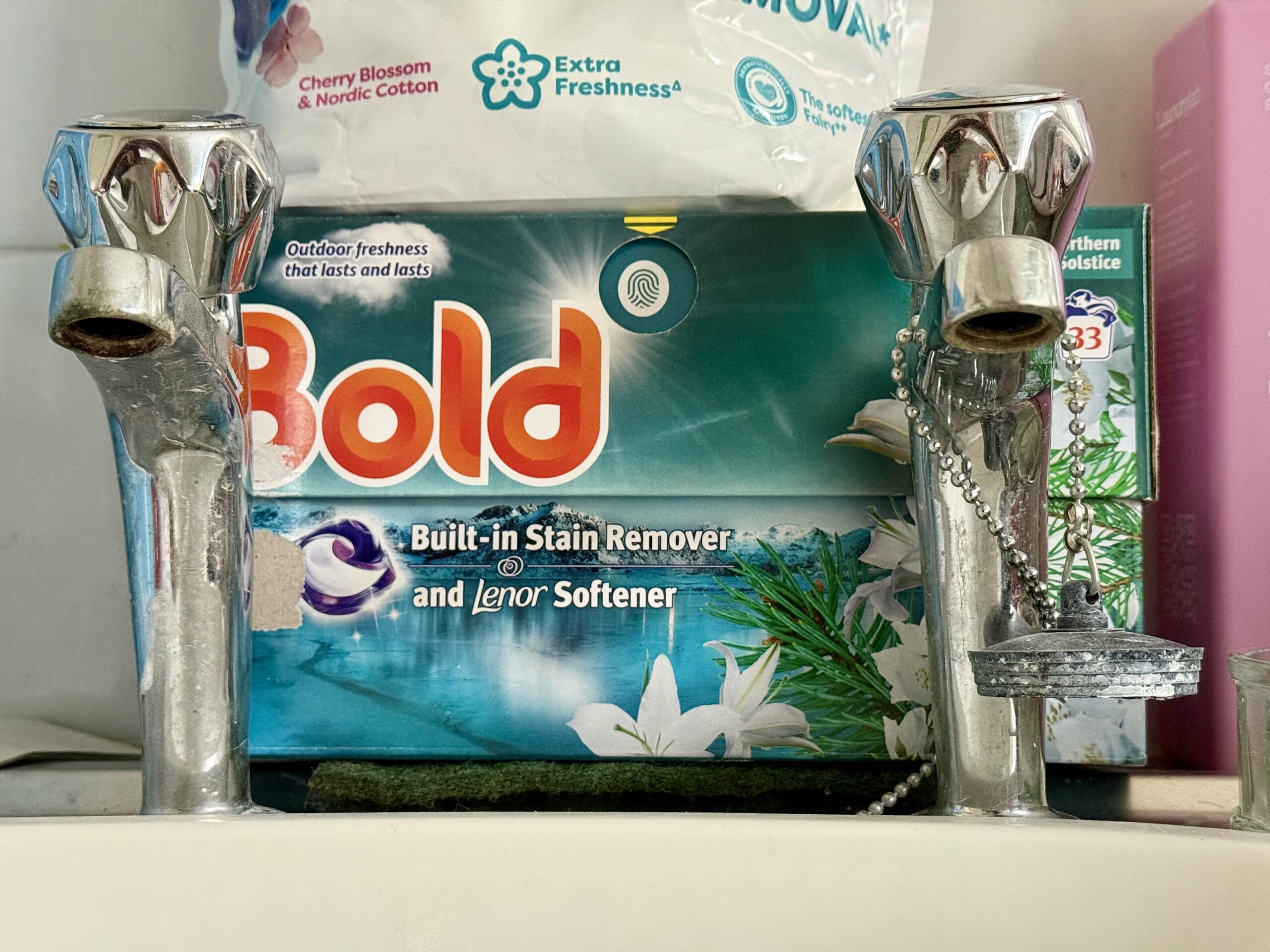
A pair of taps, left-cold, right-hot, with a box of Bold washing machine capsules behind and a pack of Fairy Big One capsules on top of that. Chances are these taps have been in the house since it was built in 1988. We have no sentimental attachment to them.

But time passed and upgrades happened. So now we have push button flushes through and mixer taps everywhere apart from the utility room.

It’s not fashion. We save money with each flush – the designs have been updated to use less water. I get it. But…

Work installed new toilets, stand-up urinals and handbasins within the last year. The toilets have a dual-button flush. The taps have proximity detectors, the urinals work off a timer. (I don’t go in the Ladies). Every time I use the flushes I must think – which button?

I need an acronym thingy, because ‘small for yellow and big for brown’ doesn’t somehow work.


  1. Great head and tag lines!

Computer assistance rejected

Have you ever proposed a solution absolutely guaranteed to fix a computer user’s stress levels to someone who continually cannot remember where they saved stuff, why they cannot figure out the contents from the names of their documents?1

And had it rejected because they know where to save stuff and know from the documents names what’s inside?

Yeah.

I know some of it’s from the stress of the demands of the task they’re involved with, a need to complete the work, but why ask for help in the first place?

In this case my lifetime2 of experience, both calculated and gained from bitter experience, counts for nothing.

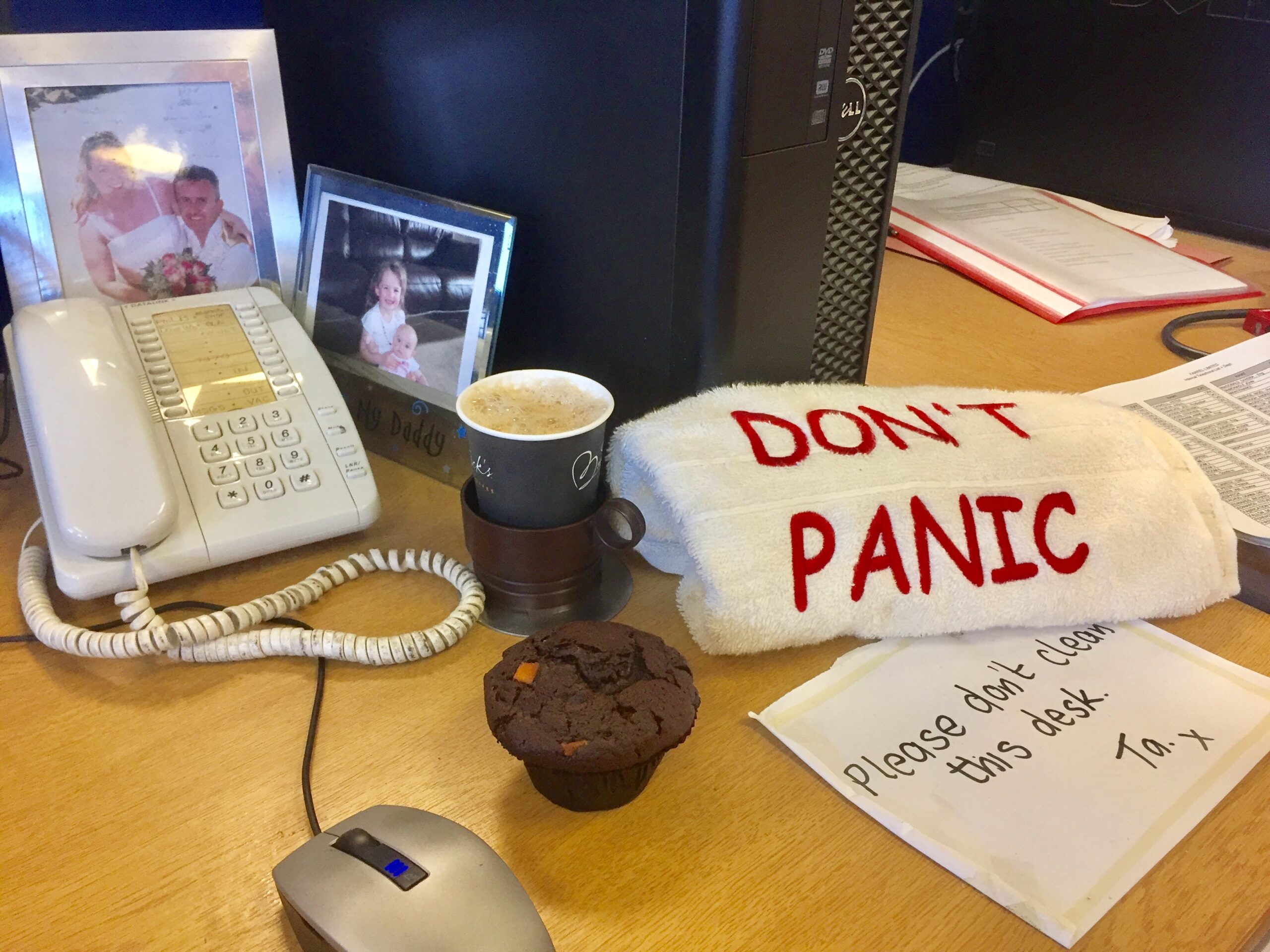
A 2017 photo of a work desk with old-fashioned phone, simple mouse, chocolate muffin, plastic cup, family photos, computer system unit, pieces of paper, and a folded towel embroidered with the words "DON'T PANIC".
A 2017 photo of a work desk with old-fashioned phone, simple mouse, chocolate muffin, plastic cup, family photos, computer system unit, pieces of paper, and a folded towel embroidered with the words “DON’T PANIC”.

Vent venty vent vent.


  1. Slightly-related link to ‘Computer assistance required’ – not my current stimulus. It’s from February 2 2014 and definitely not about the most challenging now ex-colleague I’ve ever had the pain of dealing with for 11 excruciating years: https://bt3.com/2014/02/02/computerassist/
  2. Since 1981 (when I started work) I’ve possibly owned more computers and set up and administered more systems than most.

Why I’m ambivalent about working from home

This post is a shamelessly opportunistic stream of consciousness follow up to Larry’s Why I Hate Working From Home and Jeremy’s Why I Like Working From Home. Larry’s is a response to his employer’s unwelcome shift from office to remote working across the board, and Jeremy’s more of a summary of a self-employed life. (I’ve never been able summarise, so this might be unfair; read their words first).

Like theirs, mine is a personal view. Unlike theirs I couldn’t have written this without standing on the shoulders of their giant-ness.

Erm… there’s aren’t any indications from my employer that it’s likely. Winter’s pretty much over here and there are no stay-at-home mandates, thank goodness.

Then

My experience of working from home (or working at home as I still think of it) is limited to a total of 6 months enforced by the first year of the Covid-19 pandemic. 6 years ago now. I was lucky enough to be loaned a laptop, so I could choose where I worked. Dining room table it was, spread out but stopping the proliferation of newly folded clothes we usually see.

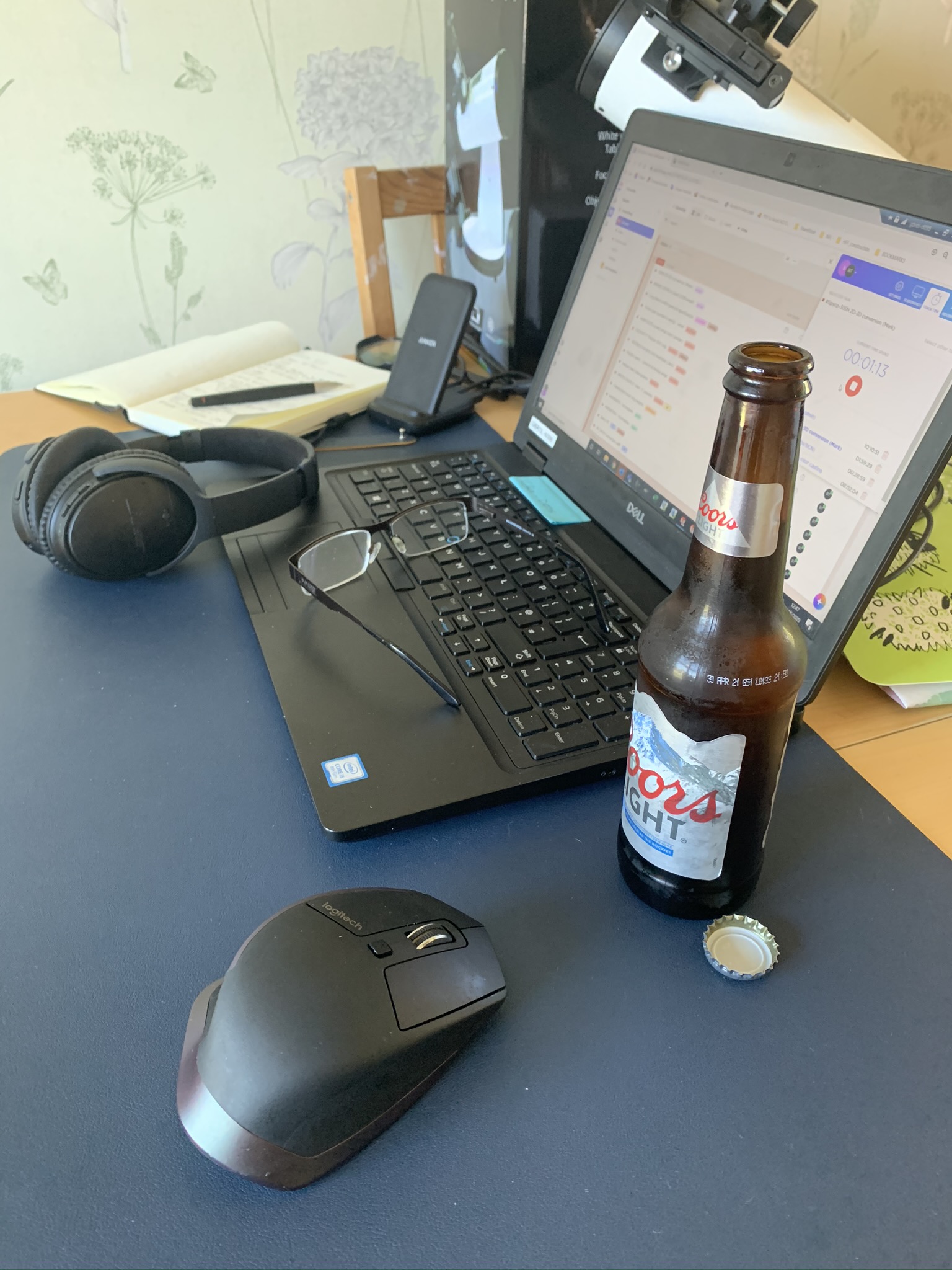
A dining room table repurposed into a working desk. Laptop, mouse, headphones, reading glasses, phone stand, notebook, 4-colour pen, opened beer, telescope…

What

I’m pretty tech-savvy so already had links to everything I needed – apart from paper records of course. And in fact I prepared the guides for the department to make their transitions easier. SharePoint, at least for me as a content creator and user, holds no scary corners now.

Teams, the Microsoft thing, was a godsend. I’ve heard other services are somehow better but I integrated SharePoint and Teams and built something useful we still rely on.

Free of casual interruptions, although my productivity didn’t exactly soar, I found my focus on even complex tasks was easily maintained. I hacked hours off jobs, created new methods that made things sustainable, and checked out all the major productivity/project planning methodologies/sites until I found one that clicked for me.

I found a comfortable niche.

Oops

My wife hated my constant presence. Hated the fact my posh headphones leaked the other side of conversations (and the music I used as a daily crutch – from bands I’d never previously have listened to). Hated my muttering when working through stuff. Hated the simple fact that she still had to travel into work.

My daughters were off school too, compounding the strife at home. I attempted to enforce a framework of study and rewards. Eventually the schools caught up and imposed some order to their education. I discovered I can’t teach, not as bad a thing as I’d thought when I began.

Now?

Not sure. I wouldn’t want to do any of it again, but if circumstances dictated I could. My girls are older, one’s at university and away most the week. The other in her final year of high school has a degree of independence I simply didn’t at her age.

We had the garage converted from a dumping ground into a room (with a heavy fireproof so sound-deadening door) and so I have choices.

We started a new contract with our broadband supplier, so speeds are easy multiples of what we had 6 years ago. 6 years ago I had to set up a supplementary router to work around a wireless bug in the ISP’s device. Again a validation of my expertise in areas unrelated to my work. (I use the term ‘expertise’ here, I think it means what it might not mean).

Bottom line

Anyway, if my employer decided to retain my services as I head towards retirement and thus obsolescence, I’d do it, sure.

What it’d do for our mental health, who knows.

When I started my working life, and even though I acquired my first home computer that year and bought into the ‘computers are our future’ ideal, no way could I have envisaged doing my job at home.

Would I want to?

Not in the same way, heck no.

And I would rather not prepare for the chance it might happen.

But maybe I don’t need to?